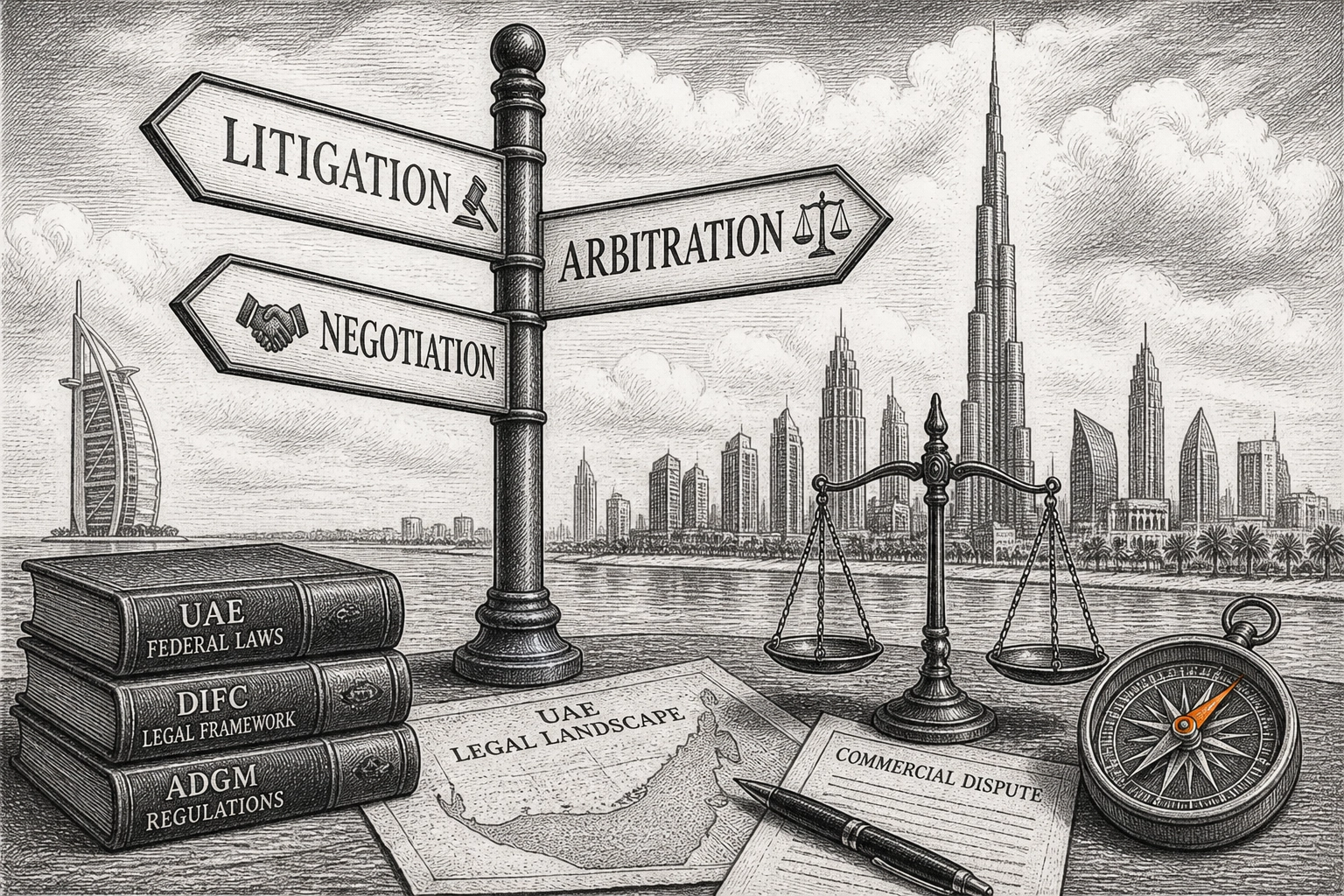
When a commercial dispute surfaces in the UAE, most businesses reach for the same lever: litigation. It is familiar, it feels decisive, and it requires no upfront strategic thinking. It is also frequently the wrong choice, and by the time that becomes clear, the costs of reversing course are already locked in.
The UAE presents something most jurisdictions do not: genuine optionality. Three distinct legal systems operate in parallel, onshore federal courts governed by civil law principles, and the common law frameworks of the DIFC and ADGM, each with different procedural rules, cost profiles, and enforcement pathways. Layered on top of that is a maturing arbitration framework and a largely underused toolkit of structured negotiation and mediation mechanisms.
Choosing intelligently among these paths is a strategic financial decision. It requires understanding forum selection clauses, enforcement risk, and time-cost trade-offs before a dispute arises, not after. This piece compares litigation, arbitration, and negotiation across the dimensions that matter most, and offers a practical decision framework for matching your dispute to the forum most likely to resolve it efficiently and on terms you can actually enforce.
Why Defaulting to Litigation Is a Strategic Error in the UAE
Most commercial contracts in the UAE include either no dispute resolution clause or a generic one inserted at the end of drafting without any forum analysis. When a dispute arises under such a contract, the parties do not choose litigation; they simply find themselves in it. The default is structural, not strategic.
That default carries real costs. Onshore federal court proceedings are conducted in Arabic, and mandatory translation requirements apply to all foreign-language documents. For international businesses whose contracts, correspondence, and records are in English, this means translation fees and delays at every procedural stage, costs that were entirely foreseeable at contract signing but rarely are.
The deeper problem is what businesses are forfeiting by not choosing. The UAE operates three distinct legal systems: onshore federal courts under a civil law framework, the DIFC Courts applying common law procedure in English, and the ADGM Courts offering a parallel common law framework in Abu Dhabi. Each has a different procedural architecture, enforcement pathway, and cost profile. A business that defaults to onshore litigation has not selected the best available option; it has failed to exercise a genuine choice.
Once proceedings begin, that choice is largely gone. Switching forums mid-dispute is rarely procedurally available and is always expensive. The costs and delays embedded in the wrong forum do not become recoverable by recognising the error later. Forum lock-in is real, and it begins the moment a claim is filed.
The strategic argument is straightforward: selecting a dispute resolution path is a financial decision with measurable consequences, not a legal formality to be tidied up at the end of contract negotiations. Getting it wrong does not just affect legal fees; it affects timelines, enforceability, confidentiality, and the ultimate commercial outcome of the dispute. As we outline in Prevention as the Best Path, the decisions made before a dispute arises consistently determine outcomes more than the decisions made during one.
The UAE Forum Landscape: Three Legal Systems, One Decision
That optionality only has value if you understand what the three systems actually are and how they differ from one another.
The UAE operates a multi-jurisdictional environment unlike most commercial markets. Each of its three forum tracks carries distinct procedural rules, language requirements, and enforcement characteristics.
Onshore federal courts are the civil law default. Proceedings are conducted in Arabic, foreign-language documents require certified translation, and the substantive framework for commercial disputes is the UAE Civil Code. Where parties have agreed to arbitration, onshore-seated proceedings follow Federal Law No. 6 of 2018 on Arbitration, which closely mirrors the UNCITRAL Model Law. The onshore system handles the majority of UAE commercial disputes by volume, largely because most contracts default to it by omission.
DIFC Courts operate as a common law jurisdiction inside Dubai's financial free zone. Proceedings are conducted in English, the bench applies precedent-based reasoning, and the procedural framework will be immediately familiar to parties accustomed to English-law contracting. Jurisdiction is not automatic; it requires either a genuine DIFC nexus (a party registered in the free zone, or a contract performed there) or an express opt-in clause. Without one of those two foundations, a DIFC jurisdiction clause may not hold.
ADGM Courts run a parallel common law structure in Abu Dhabi's financial free zone, governed by the ADGM Arbitration Regulations 2015. Procedure, language, and precedent-based reasoning mirror the DIFC model. Natro Legal Associates is registered in ADGM and regularly advises on proceedings in this jurisdiction.
The predictability gap between the two frameworks is material. Civil law courts exercise broader judicial discretion without binding precedent; common law courts in DIFC and ADGM produce reasoned, citable judgments that allow parties to assess outcomes with greater confidence before committing to a position.
Forum selection also determines your default arbitration seat. DIAC's 2022 Rules designate onshore Dubai as the default seat where parties have not agreed otherwise; ArbitrateAD's 2024 Rules designate Abu Dhabi. A contract that names the wrong institution, or names none at all, may land in a seat and procedural framework the parties never intended.
Litigation, Arbitration, and Negotiation Compared Across Four Dimensions
Knowing which forum governs your contract is only part of the equation. How each dispute resolution path performs across time, cost, enforceability, and confidentiality determines whether that forum choice actually serves your commercial interests.
Time is where the gaps are sharpest. Onshore court litigation routinely extends beyond 18 to 24 months through first instance and appeal, with mandatory Arabic translation requirements adding delay at every procedural stage. Institutional arbitration under DIAC or ArbitrateAD typically concludes within 12 to 18 months. Structured mediation can resolve disputes in weeks. For commercial parties managing cash flow, receivables, or time-sensitive contracts, that differential is not procedural; it is financial.
Cost requires a more nuanced read. Litigation appears cheaper at the outset but accumulates through extended legal fees, translation costs, and multiple hearing rounds. Arbitration front-loads cost through institutional registration fees and tribunal compensation, but the compressed timeline limits total elapsed spend. Negotiation and mediation carry the lowest gross cost of all three paths, but they require counterparty willingness and produce no enforceable outcome unless the parties execute a formal settlement agreement. Lowest entry cost does not mean lowest total cost if the process fails and litigation follows.
Enforceability is frequently the decisive variable for cross-border disputes. Onshore UAE court judgments are enforceable domestically and across GCC treaty partners, but recognition outside those jurisdictions is variable. Arbitral awards carry a structurally different advantage: the UAE acceded to the New York Convention in 2006, giving awards enforcement access across 170+ signatory states. Where a counterparty holds assets offshore or is a foreign-incorporated entity, that enforcement reach is not a marginal benefit; it is often the difference between a recoverable award and an unenforceable one.
Confidentiality closes the comparison. Court proceedings are public by nature. Arbitration proceedings and awards are confidential by default under both DIAC and ArbitrateAD institutional rules, a material consideration for disputes involving sensitive pricing, proprietary arrangements, or relationships that litigation exposure would damage regardless of outcome.
DIAC continues to administer several hundred cases each year, a significant share of them seated onshore in Dubai, with 51% of that caseload seated in onshore Dubai. Onshore arbitration is not a compromise position. For parties whose dispute resolution needs sit across all four dimensions above, our expertise in commercial litigation and dispute resolution spans each of these paths and forums.
Arbitration in the UAE: Institutions, Rules, and What Changed After DIFC-LCIA
Choosing the right institution matters as much as choosing arbitration itself, and the UAE's institutional landscape shifted materially in 2021.
The abolition of the DIFC-LCIA Arbitration Centre consolidated UAE arbitration activity into two primary institutions: DIAC (Dubai International Arbitration Centre) and ArbitrateAD in Abu Dhabi. Both responded with modernised rules aligned with contemporary international standards. DIAC's 2022 Rules introduced a default Dubai seat where parties have not specified otherwise, expedited procedure provisions for lower-value or time-sensitive disputes, and enhanced emergency arbitrator mechanisms. ArbitrateAD's 2024 Rules reflect parallel modernisation, designating Abu Dhabi as the default seat on the same basis. Fewer institutions now compete for UAE arbitration business, but the choice between them is cleaner and better defined.
The governing law framework is equally structured. Federal Law No 6 of 2018 governs onshore-seated arbitrations and closely mirrors the UNCITRAL Model Law, giving international practitioners familiar procedural ground without needing to relearn foundational principles. For DIFC-seated arbitrations, DIFC Arbitration Law No 1 of 2008 applies and similarly tracks the Model Law, reinforcing DIFC's standing as a neutral, internationally recognised seat for cross-border commercial disputes. Understanding how these systems interact is part of a multi-layered legal system that rewards early structural thinking.
For businesses drafting contracts today, the consolidation simplifies the threshold question without eliminating it. The relevant variables are:
DIAC: appropriate where the contract has a Dubai nexus and onshore proceedings are acceptable
ArbitrateAD: appropriate where the Abu Dhabi nexus is stronger or onshore Abu Dhabi proceedings are preferred
DIFC: suited to international commercial contracts where common law procedure, English-language proceedings, and cross-border enforceability are priorities
ADGM: a comparable common law alternative for Abu Dhabi-based or ADGM-registered counterparties
The institution determines the default seat, the procedural rules, and the supervisory court. Getting that selection right in the contract clause is the prerequisite for everything that follows.
Which Forum Fits Which Dispute: Sector-by-Sector Guidance
Knowing which institutions govern UAE arbitration is only half the analysis. The more consequential question is whether a given dispute type is suited to arbitration at all, or whether forum choice is effectively made for you by law.
Real Estate
Onshore courts hold exclusive jurisdiction over disputes involving registered land and off-plan property under UAE law. Arbitration clauses in real estate contracts do not override this; parties who include them may find the clause unenforceable when a dispute materialises. Before drafting any dispute resolution clause into a property agreement, verify whether the subject matter falls within mandatory onshore jurisdiction.
Banking and Finance
For international financial institutions, the DIFC Courts are the natural forum. Common law procedure, English-language proceedings, and a commercially sophisticated bench make DIFC the preferred venue for cross-border finance disputes. Entities incorporated in DIFC, or operating under DIFC-governed agreements, should specify either DIFC court jurisdiction or DIFC-seated arbitration explicitly in their contracts; a generic clause creates unnecessary ambiguity.
Commercial Contracts and M&A
Institutional arbitration under DIAC or ArbitrateAD is the established standard for complex commercial disputes and cross-border transactions. The combination of confidentiality, party-selected tribunal expertise, and New York Convention enforcement across 170+ states makes arbitration the rational choice whenever a non-UAE entity is party to the contract. Disputes that may require enforcement against offshore assets should not be routed to onshore litigation by default.
Gaming and I-Gaming
The international counterparty profile of the gaming sector, combined with the reputational sensitivity of commercial disputes in this space, makes public litigation a poor fit. ADGM-seated or DIFC-seated arbitration provides confidentiality and cross-border enforceability that onshore court proceedings cannot. Our commercial cases practice includes specialist dispute resolution strategy for i-gaming and e-gaming operators, addressing the specific risk profile this sector presents.
Labour and Employment
Onshore courts retain mandatory jurisdiction over employment disputes governed by UAE Labour Law. Arbitration clauses inserted into employment contracts do not displace this jurisdiction. Businesses should structure their employment agreements with this constraint in mind, rather than assuming a standard arbitration clause will hold.
Forum Selection Clauses: What to Draft Before a Dispute Arises
Knowing which forum suits your dispute type is only half the equation. The other half is ensuring your contract actually gets you there.
A complete forum selection clause specifies six elements: governing law, dispute resolution mechanism (litigation, arbitration, or a stepped escalation process), the institution and rules if arbitration is chosen, the seat of arbitration, the language of proceedings, and the number of arbitrators. Omitting any one of these creates ambiguity that an adverse party can exploit to delay proceedings, challenge jurisdiction, or force a forum change at your expense. Note that DIAC's 2022 Rules and ArbitrateAD's 2024 Rules each designate a default seat when parties have not agreed, so silence on seat is not neutral; it hands that decision to the institution.
Multi-tiered escalation clauses require parties to attempt negotiation or mediation before invoking arbitration or litigation. When properly drafted with defined timelines and clear trigger conditions, these clauses resolve a meaningful share of disputes at the earliest, cheapest stage without surrendering the right to proceed formally. The key word is "properly": a clause that requires negotiation but sets no deadline is a procedural obstacle, not a cost-saving mechanism.
Pathological clauses are a persistent problem in UAE commercial contracts. These reference institutions that no longer exist (such as the former DIFC-LCIA), specify contradictory procedural rules, or designate incompatible seats. The consequence is potentially severe: an unenforceable arbitration agreement defaults the parties back to onshore litigation regardless of what they intended. The UAE's multi-jurisdictional dimension makes this risk higher than in single-forum markets, because more combinations of institution, seat, and governing law are possible, and more of them conflict.
Asymmetric jurisdiction clauses, common in financing and guarantee arrangements, give one party the right to elect forum while binding the counterparty to a single forum. These are generally enforceable in DIFC and ADGM. Onshore enforceability is less settled and requires specific drafting review before execution.
The practical conclusion: forum clause review belongs in contract drafting and due diligence, not in the dispute itself. Counsel engagement at the drafting stage costs a fraction of what a jurisdictional challenge costs once a relationship has broken down.
Enforcement After the Award or Judgment: Cross-Border Realities
Getting the forum selection clause right is only half the equation. The other half is whether an award or judgment, once obtained, can actually reach the counterparty's assets.
Arbitral awards carry the strongest cross-border reach. The UAE acceded to the New York Convention in 2006, and the Convention now has 172 contracting states. That coverage includes the UK, US, EU member states, Singapore, and India, meaning a UAE-seated arbitral award can be submitted for recognition in those jurisdictions through a relatively standardised process. Foreign court judgments carry no equivalent multilateral framework; enforcement depends on whether a bilateral treaty exists, and many do not.
Onshore UAE court judgments have a more defined but narrower enforcement footprint. Recognition across GCC states is available under the GCC Enforcement Convention, and select bilateral treaties extend enforcement to additional jurisdictions. Outside those treaty partners, onshore judgments face materially variable recognition. For any dispute involving a counterparty whose assets are held in the UK, US, or Asia-Pacific, an onshore court judgment is a weaker instrument than an arbitral award from the outset.
DIFC Court judgments occupy a different position. The DIFC Courts have signed memoranda of guidance with the English Courts and the Courts of Singapore, facilitating recognition in those jurisdictions. The DIFC-Dubai judicial gateway provides a reciprocal enforcement mechanism between the DIFC and onshore UAE courts, allowing DIFC judgments to be converted and enforced against assets located in onshore Dubai. This makes DIFC a genuinely useful forum where a counterparty holds assets across both systems. Our banking and finance dispute expertise frequently involves navigating exactly this cross-system enforcement structure.
The practical implication is straightforward. If a counterparty holds assets offshore or is a foreign-incorporated entity, the New York Convention enforcement pathway is frequently the most reliable route to actual recovery. Selecting arbitration for that reason alone is a legitimate strategic decision.
Enforcement planning should begin at contract inception: identify where the counterparty holds assets, confirm which jurisdictions those assets are in, and verify whether those jurisdictions are Convention signatories or bilateral treaty partners with the UAE. That analysis costs very little at the drafting stage and can determine which forum clause is worth insisting on.
Structured Negotiation and Mediation: The Underused Third Path
Enforcement pathways matter only if you reach an award or judgment. Many disputes should never get that far.
Mediation and structured negotiation remain the least-used tools in UAE commercial dispute resolution, despite offering the lowest cost, the shortest timeline, and the greatest control over outcome. The reason they are underused is largely definitional: businesses conflate informal negotiation, which frequently stalls when positions harden, with structured mediation conducted by a neutral third party under agreed procedural rules. These are different processes producing different results.
Institutionally, the consolidation of DIFC-LCIA into DIAC and ArbitrateAD has brought mediation closer to the centre of UAE dispute resolution practice. DIAC published dedicated Mediation Rules in 2023 and positions mediation as a formal service alongside arbitration. This is not incidental: both institutions now treat mediation as a complementary mechanism rather than an informal precursor, and well-drafted multi-tiered clauses can require mediation as a condition precedent before arbitration proceedings may be commenced.
Mediation is most likely to deliver value when:
The commercial relationship has continuing worth that adversarial proceedings would damage or destroy
The dispute rests on a factual disagreement rather than an established legal right
Both parties face liquidity constraints that make 12 to 18 months of institutional arbitration commercially damaging
The contract already contains a stepped dispute resolution clause requiring mediation before arbitration
Structured negotiation, as distinct from an informal exchange of positions, adds enforceable weight to the process. A framework with defined timelines, confirmed authority levels on both sides, and a written settlement agreement executed before any formal filing captures the speed and cost advantages of negotiation while producing a document that has legal effect. That settlement agreement can then be filed as a consent award in arbitration, giving it New York Convention-enforceable status across 170+ signatory states, a result that informal negotiation rarely achieves.
The critical timing point: mediation candidacy should be assessed at the outset of any dispute, before filings occur and before positions calcify through formal submissions. Businesses handling commercial cases that enter arbitration or litigation without first evaluating mediation often foreclose a faster, cheaper path that was available at the start.
A Decision Framework: Matching Your Dispute to the Right Path
Knowing your options is only half the decision. The other half is applying a consistent analytical sequence before a single document is filed. Here is a five-step framework for doing that.
Step 1: Read the contract first. Identify whether a dispute resolution clause exists, and if so, what it specifies: forum, seat, governing law, institution, and number of arbitrators. A clause that names a non-existent institution or contradicts its own governing law may be unenforceable as written, which changes everything that follows. Resolve clause validity before assessing any other variable.
Step 2: Assess the counterparty's asset profile. A foreign entity with assets held offshore is best pursued through institutional arbitration; the New York Convention, to which the UAE acceded in 2006, provides enforcement access across 170+ signatory states that no court judgment reliably matches. A UAE-registered counterparty with domestic assets presents different calculus: onshore litigation or DIFC/ADGM proceedings may recover just as effectively at lower cost, depending on the governing law in the contract.
Step 3: Quantify the dispute value against the forum cost. Disputes under approximately AED 500,000 rarely justify institutional arbitration fees and tribunal costs; the net recovery after fees frequently compares unfavourably to an onshore court filing or a structured negotiated settlement. High-value or complex disputes justify the upfront arbitration premium for the procedural control, tribunal expertise, and enforcement certainty that institutional arbitration delivers.
Step 4: Evaluate the commercial relationship. If the counterparty is a supplier, distributor, or partner you intend to continue working with, adversarial proceedings carry a cost that does not appear on any fee schedule. Mediation or structured negotiation preserves optionality; litigation and arbitration rarely do.
Step 5: Engage counsel before filing anything. The moment a claim is lodged in any forum, procedural timelines lock in, costs accumulate, and strategic alternatives close off. Pre-dispute counsel engagement is not a discretionary expense; it is a hedge against the considerably larger cost of proceeding in the wrong forum from the outset.
Dispute Resolution Strategy Starts Before the Dispute
The decision framework above tells you what to do once a dispute surfaces. The more valuable insight is simpler: if your contracts are properly drafted, most of that framework becomes redundant.
The UAE's three-forum architecture, onshore courts, DIFC, and ADGM, gives businesses genuine optionality that most commercial jurisdictions cannot match. That optionality expires at signing. A forum selection clause reviewed at the contract drafting stage costs a fraction of a contested jurisdiction argument mid-dispute, and the gap widens considerably once translation requirements, procedural delays, and forum-switching costs enter the calculation.
Litigation, arbitration, and structured negotiation are not interchangeable defaults. They diverge materially on cost, timeline, confidentiality, and cross-border enforceability. The right mechanism depends on three variables specific to each commercial relationship: the counterparty's asset profile, the value and complexity of the potential dispute, and whether the relationship has ongoing commercial value worth preserving. No generic clause addresses all three.
Natro Legal Associates advises businesses on pre-dispute strategy and forum selection clause drafting across onshore UAE courts, DIFC, and ADGM. Registered in ADGM and active across the UAE's full jurisdictional landscape, NLA combines direct partner access with commercially grounded advice rather than the templated, volume-driven output of larger practices. Clients receive counsel calibrated to their specific contract portfolio and counterparty exposure, not a standardised clause lifted from a precedent bank.
Businesses entering the UAE, restructuring existing commercial relationships, or conducting a legal audit of their contract portfolio should treat dispute resolution clause review as a standard line item, not an optional add-on. The cost of a pre-dispute strategy review is fixed and modest. The cost of the wrong forum is variable and, once locked in, unrecoverable.
To discuss a pre-dispute strategy review tailored to your commercial contracts and UAE jurisdictional exposure, contact Natro Legal Associates directly.
Conclusion
Dispute resolution in the UAE is a strategic decision, not a default setting. Three takeaways define the practical stakes: first, litigation, arbitration, and negotiation carry materially different outcomes depending on your counterparty, assets, and jurisdiction; second, the UAE's three-forum landscape creates genuine complexity that generic contracts routinely ignore; third, the moment a dispute crystallises is already too late to optimise your position.
Forum selection is not legal housekeeping. It is commercial leverage, decided before the contract is signed.
Businesses operating in the UAE should audit their dispute resolution clauses now, while options remain open and costs remain fixed. Natro Legal Associates provides pre-dispute strategy reviews tailored to your specific contract portfolio and jurisdictional exposure.
The right forum protects your position. The wrong one locks you into a path you cannot reverse. Choose deliberately.