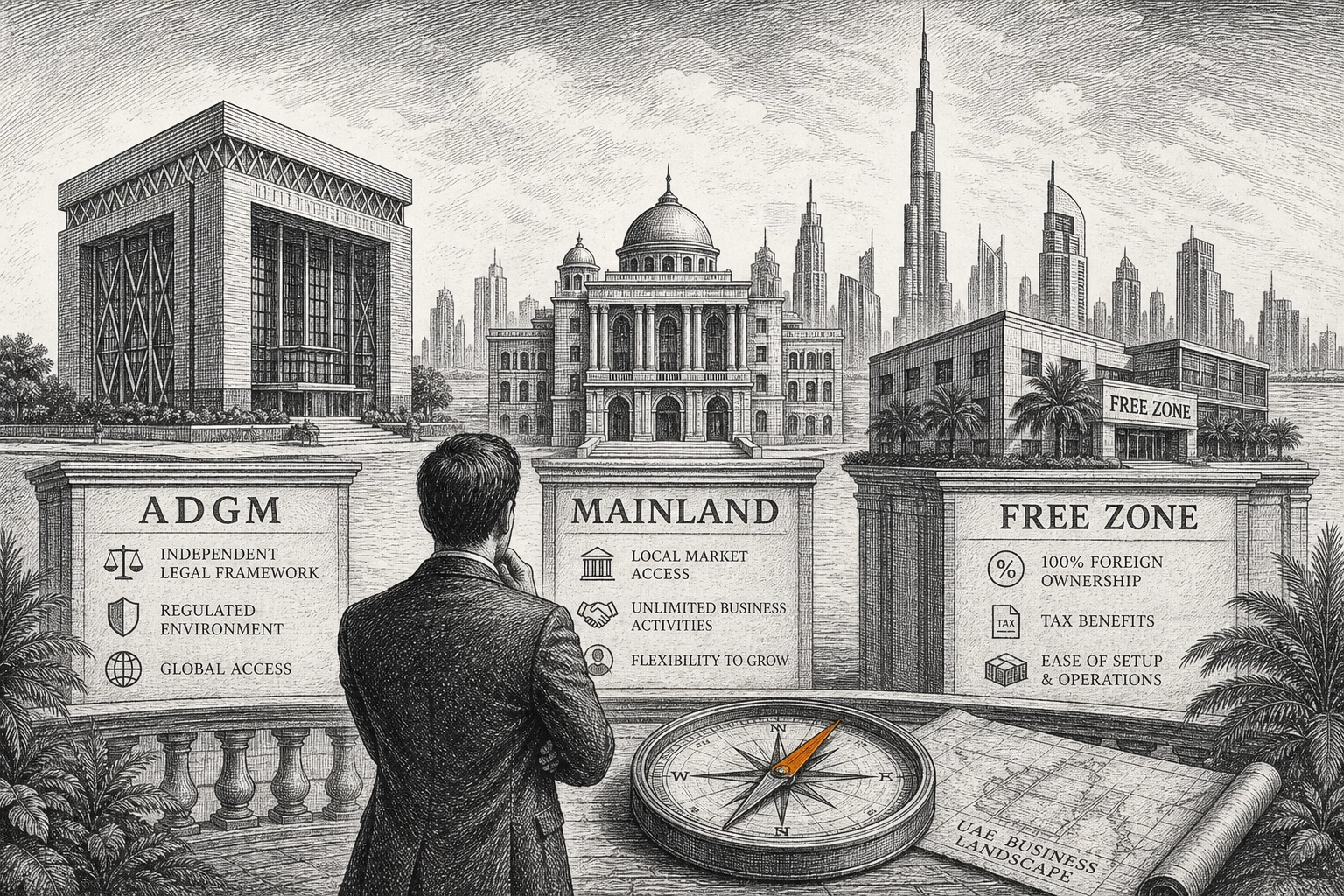
Most businesses entering the UAE treat jurisdiction selection as an administrative formality. It is not. The entity structure you choose on day one determines your legal framework, your ownership rights, your tax position, and your ability to operate where your customers actually are. Getting it wrong is not a minor inconvenience; it is an expensive structural problem that can take months and significant capital to unwind.
Company formation in UAE involves three fundamentally different tracks: ADGM, mainland, and free zone. Each operates under a distinct legal regime, serves a different business profile, and creates different obligations. ADGM sits under English common law, largely independent of federal civil law. Mainland entities fall under the Commercial Companies Law and offer direct access to the UAE domestic market. Free zones provide foreign ownership and simplified setup, but come with trade restrictions that many founders underestimate until it is too late.
This post will not walk you through a formation checklist. Instead, it gives you a decision framework covering legal structure, tax implications, activity licensing, ownership rules, and the real cost of migrating from the wrong jurisdiction, so you can choose correctly before it costs you.
The Wrong Jurisdiction Choice Is Expensive to Undo
The UAE operates three legally distinct regulatory tiers, not administrative variants, and choosing the wrong one creates structural, not procedural, consequences. Migrating to a different structure requires new licensing, full re-registration, contract novation with every counterparty, and in many cases a complete wind-down and re-incorporation. The professional fees can be substantial before any account is taken of business interruption.
The landscape shifted again in 2025. Federal Decree-Law No. 20 of 2025 amended the Commercial Companies Law, clarifying jurisdictional boundaries between mainland and free zone entities and introducing substantive changes to ownership rules, shareholder instruments, and governance obligations. Businesses structured before this amendment, particularly those that relied on ownership or governance assumptions from the 2021 framework, should treat the current period as a review trigger rather than a stable baseline.
Fragmentation is not stabilising; it is accelerating. As ADGM, DIFC, and the Ministry of Economy each develop divergent compliance pathways, the operational gap between a well-matched structure and a poorly-matched one compounds annually. Staying current with Navigating the UAE's Evolving Regulatory Landscape is no longer optional for businesses with material UAE exposure.
The practical conclusion is straightforward. A jurisdiction strategy review before formation costs a fraction of a post-launch restructuring. The sections that follow give you the framework to make that decision correctly the first time.
ADGM: Built for Financial Services, Professional Firms, and International Capital
Of the three jurisdictions, ADGM is the most precisely engineered for a specific purpose. Understanding what it is built for, and what it is not, is the starting point for any serious ADGM company setup decision.
The legal foundation is the critical differentiator. ADGM operates under English common law by constitutional exemption from UAE federal civil law, established under Federal Decree No. 15 of 2013. This is not a procedural detail. It means contract interpretation, corporate governance standards, director duties, and enforcement pathways all follow a framework that international investors, counsel, and counterparties already understand. For a business raising capital from a London or Singapore-based fund, or entering cross-border commercial agreements, the governing law is a substantive negotiating point, not a formality.
Ownership structure is clean from the outset. ADGM operates as an independent legal jurisdiction with its own civil and commercial laws, and its corporate framework is generally designed to accommodate international investment structures, confirm ownership and sponsor requirements with ADGM regulatory guidance for your specific entity type. For venture-backed businesses in particular, a cap table that requires explanation is a liability at every funding round.
Sector fit is not incidental; it is structural. ADGM hosts several thousand registered entities across financial services, fintech, asset management, and professional services, with financial activities regulated by the Financial Services Regulatory Authority. For operators in regulated sectors, including those seeking precision counsel for the UAE's digital asset and fintech economy or an i-gaming regulatory base, the ADGM licence is itself a strategic asset. The regulatory framework, built to align with FATF and IOSCO standards, signals institutional credibility to counterparties and investors in a way that a general trading licence cannot replicate.
Dispute resolution is English-language and internationally recognised. The ADGM Courts operate independently of the UAE federal judiciary. Proceedings are conducted in English under common law rules. For shareholder agreements, VC term sheets, and cross-border commercial contracts, this provides an enforcement pathway that international parties will accept without negotiation.
One material limitation must be stated plainly. ADGM entities do not hold automatic rights to trade onshore in the UAE domestic market. A business that needs to sell goods or services directly to UAE-mainland customers requires either a separate mainland licence or a local distribution arrangement. ADGM is not the right primary structure for domestic-facing businesses; it is the right structure for internationally oriented ones.
For holding companies and SPVs, ADGM's corporate framework aligns directly with standard international investment documentation, reducing friction at funding rounds and exit events in ways that mainland or non-financial free zone structures typically cannot match.
Mainland UAE: The Right Structure for Domestic Market Access and GCC Operations
Where ADGM serves businesses oriented toward international capital and regulated financial activity, mainland company formation in UAE serves a fundamentally different purpose: direct, unrestricted access to the UAE domestic market and the broader GCC commercial environment.
The governing framework
Mainland LLCs operate under Federal Decree-Law No 32 of 2021 on Commercial Companies, most recently amended by Federal Decree-Law No 20 of 2025, which took effect in October 2025. This is a civil law framework, with federal oversight and enforcement through UAE courts conducting proceedings in Arabic. That legal environment is not a weakness for the right business profile; it is the appropriate forum for companies whose counterparties, suppliers, and clients are primarily UAE-based and whose contracts do not require international arbitration or cross-border enforcement.
What mainland uniquely provides
A mainland LLC is the only UAE structure with unrestricted domestic market access. Mainland entities can trade directly across all seven emirates, bid on federal and emirate-level government contracts, and operate in sectors either unavailable or restricted within free zones. No other structure delivers this combination. Free zone entities selling goods or services onshore require a separate mainland licence or a local commercial agent arrangement; ADGM entities face the same constraint.
Foreign ownership: liberalised, but not universal
The 2021 CCL removed ownership restrictions for most commercial activities, and the 2025 amendments extended structural flexibility further, introducing updated shareholder instruments and new pathways for mergers and re-domiciliation. However, the permitted foreign ownership percentage remains activity-dependent. A blanket assumption of 100% foreign ownership across all mainland licence categories is incorrect; the actual position depends on the specific licensed activity.
The compliance review trigger
The pace of regulatory change on the mainland has been significant. Businesses incorporated under pre-2025 structures should treat the current period as a natural review trigger: recent amendments have updated shareholder rights, governance obligations, and director liability standards in ways that may render prior arrangements non-compliant without corrective action.
Who mainland is built for
Mainland company formation is the correct default for B2B trading companies, retail operators, contractors, healthcare providers, hospitality businesses, and any operation whose revenue depends on physical UAE market presence or government sector engagement. If your customers are in the UAE and your contracts are governed by UAE law, the mainland is not a compromise choice; it is the structurally correct one.
Free Zone Company Formation in UAE: Export-Oriented, Not a Universal Shortcut
Where mainland structures serve businesses rooted in the UAE domestic market, free zones are built for a different commercial profile entirely: import-export, re-export, international trading, and e-commerce operations that do not need to sell directly to UAE onshore customers. That distinction matters more than the headline benefits.
Freezone company formation in UAE does offer genuine advantages: 100% foreign ownership as standard, streamlined incorporation, and in many cases zone-specific infrastructure and networks relevant to a particular sector. The problem is that these benefits are frequently cited as a reason to default to a free zone without asking whether the free zone model matches the business's actual revenue structure.
The Hybrid Legal Tier Most Founders Overlook
Non-financial free zones, including JAFZA, RAKEZ, DMCC, and the many others across the UAE, occupy a hybrid legal position. They are neither subject to UAE federal civil law in full nor governed by common law. Each zone operates under its own corporate regulations, with dispute resolution options that vary by zone. Some have dedicated tribunals; others route commercial disputes back to mainland courts. The legal framework a business operates under is therefore not determined at the free zone tier level. It is determined by which specific zone it selects.
This zone-level fragmentation has a practical consequence: a business licensed through one free zone cannot operate from another zone's premises under that licence. For most standard trading activities, this is a manageable constraint. For regulated sectors, such as financial services, healthcare, or i-gaming, it becomes a decisive factor. Licences for these activities are only available in designated zones with the relevant regulatory authority in place. Choosing the wrong zone does not just mean a suboptimal setup; it means the activity cannot be licensed at all from that address.
Zone Selection Is a Substantive Decision
The proliferation of free zones has created a genuinely fragmented market. Numerous zones compete for incorporations, and the variation in cost structures is material. Setup fees, annual renewal costs, visa allocation limits, and office or flexi-desk requirements differ enough across zones to produce meaningfully different operating cost profiles over the first three years. A zone that appears competitively priced at incorporation may carry higher renewal costs or restrict visa quotas in ways that affect staffing plans.
For businesses evaluating company opening in a free zone, the zone selection decision deserves the same rigour as the tier decision itself. The right zone depends on the specific activity, the regulatory body that governs it, the required substance level, and the cost trajectory. Selecting a zone primarily on incorporation speed or promotional pricing, without mapping those factors, is one of the more common and correctable structuring errors we encounter.
Head-to-Head: ADGM, Mainland, and Free Zone Compared
With the three jurisdictions examined individually, the differences across legal system, ownership, market access, and dispute resolution sharpen considerably when placed side by side. The UAE's multi-layered legal system is not a bureaucratic detail; it determines which courts govern your contracts, who can own your company, and whether your sector can be licensed at all.
Dimension | ADGM | Mainland | Non-Financial Free Zone |
|---|---|---|---|
Legal system | English common law; constitutionally exempt from UAE federal civil and commercial law | UAE federal civil law; CCL (Federal Decree-Law No 32 of 2021, as amended 2025) | Hybrid; zone-specific regulations, with varying CCL influence |
Foreign ownership | 100% as standard | Activity-dependent under 2025 CCL amendments; not a blanket guarantee | 100% as standard in most zones |
UAE domestic market access | Not available without a separate mainland licence or commercial agent | Unrestricted | Not available without a separate mainland licence or commercial agent |
Regulated sector licensing | FSRA issues financial services and certain regulated digital activity licences; commercial gaming itself is licensed federally by the GCGRA, with ADGM used as a common-law corporate base | Sector-specific; regulated financial activities not available | Generally unavailable for financial services, fintech, or i-gaming |
Dispute resolution | ADGM Courts or ADGM Arbitration Centre; English law, English language | UAE federal courts; civil law, Arabic language | Varies; some zones have own tribunals, others default to mainland courts |
Switching cost tier | Destination, not origin; migration in requires full re-incorporation | Mid-tier; restructuring to ADGM requires new entity and contract novation | Entry-level to mid; migration to ADGM involves full re-incorporation and regulatory re-approval |
Two dimensions carry disproportionate weight in practice. First, regulated sector licensing is non-negotiable: if your activity requires FSRA authorisation, ADGM is the only viable path in Abu Dhabi. No administrative workaround substitutes for the relevant regulator sitting inside your jurisdiction. Second, switching costs scale with operational maturity. Migration to ADGM from either mainland or a free zone is not an administrative transfer; it requires dissolving or deregistering the original entity, re-incorporating under ADGM company law, re-executing material contracts, and seeking fresh regulatory approvals where a licence is involved.
Which Structure Fits Your Business Profile? A Practical Decision Framework
The comparison table above maps the structural differences. What it cannot do is apply them to your specific situation. The six profiles below do that work.
Fintech or financial services startup with international VC backing. ADGM is the correct answer. Common law governance, the FSRA licensing pathway, cap table structures that align with standard international term sheets, and ADGM Courts for shareholder agreement enforcement all point in one direction. For founders working with precision counsel for the UAE's digital asset and fintech economy, the regulatory framework itself is a commercial asset, not a formality.
Regional B2B trading company selling to UAE businesses and GCC clients. Mainland LLC is the most defensible structure. Unrestricted domestic market access, government tender eligibility, and a legal framework that UAE counterparties recognise and can enforce against are not replicable from a free zone address. If your revenue depends on UAE-onshore commercial relationships, your entity structure should match that reality.
International professional services firm opening a UAE office. The answer splits on client base. ADGM suits firms requiring a regulated professional licence and international contract governance; its English law framework reduces friction on cross-border engagements. Mainland suits firms whose clients are UAE-onshore and whose work is governed by local law. The wrong choice here creates a structural mismatch between where the law says you operate and where your clients actually sit.
E-commerce or digital goods operator serving international customers. A well-chosen non-financial free zone, DMCC and RAKEZ among the more established options, typically provides the right balance of cost, 100% ownership, and operational flexibility. The critical condition: no UAE-onshore retail activity. The moment direct domestic sales enter the model, a separate mainland arrangement becomes necessary.
I-gaming or e-gaming operator seeking a UAE regulatory base. Commercial gaming in the UAE is licensed federally by the General Commercial Gaming Regulatory Authority (GCGRA), while ADGM provides the common-law corporate and structuring base that operators in this sector typically require. That combination — federal gaming licence plus a credible, internationally recognised corporate home — is not replicated by a general free-zone or mainland setup. Structuring here is a compliance matter, not a cost-optimisation exercise. Operators who structure elsewhere and attempt to access this regulatory environment later face full re-authorisation, not a simple transfer.
Holding company or SPV for regional investment or asset structuring. ADGM SPV structures are purpose-built for this use case. English law governance, recognisable to international counterparties, and capable of holding assets or subsidiaries across multiple jurisdictions make ADGM the default for regional structuring work where international capital or cross-border enforcement is in scope.
What Migrating from the Wrong Jurisdiction Actually Costs
Knowing which structure fits your profile is one decision. Understanding what it costs to correct a wrong one is what makes that decision urgent.
Jurisdiction migration is not an administrative update. It requires deregistering or dissolving the original entity, incorporating afresh in the target jurisdiction, re-executing or novating material contracts, reapplying for any licences or regulatory approvals, and formally notifying banks, counterparties, and tax authorities. Each of those steps carries professional fees, regulatory timelines, and operational exposure.
For a business with active client contracts, employees, and established banking relationships, the direct legal and administrative costs can be material before any account is taken of business interruption, revenue deferral, or the management time diverted from operations to restructuring.
The 2025 CCL amendments create a specific review trigger. Federal Decree-Law No 20 of 2025 altered the mainland compliance environment, including governance obligations and certain ownership provisions. Businesses that structured under pre-2025 assumptions, particularly around foreign ownership percentages or shareholder arrangements, should treat the current period as a natural point to confirm those structures remain compliant. The cost of a review now is a fraction of what remediation costs once operational complexity has deepened.
Regulated licences are the hardest element to migrate. An FSRA authorisation under ADGM is not portable from another zone. It must be applied for from scratch, with full regulatory scrutiny, capital adequacy assessment, and processing timelines that can extend to several months. The FSRA's recently proposed transfer framework confirms that even intra-ADGM business transfers attract regulatory oversight; cross-jurisdiction transitions involve considerably more.
The cost curve is steep and non-linear. A jurisdiction review before formation is a few hours of senior counsel time. A correction at Year 1, before contracts and banking relationships have consolidated, is manageable. At Year 3, with operational depth, multiple counterparty agreements, and an established banking profile, the same correction becomes a material business event, not a legal formality.
The case for early precision is not theoretical. It is arithmetic.
Corporate Tax, Treaties, and How Jurisdiction Affects Your Tax Position
Restructuring costs are not the only expense the wrong jurisdiction creates. Tax positioning is equally sensitive to the initial structural decision, and it is harder to fix retrospectively.
UAE corporate tax, introduced under Federal Decree-Law No. 47 of 2022 and effective from 2023, applies at 9% on taxable income above AED 375,000 across mainland and free zone entities alike. Qualifying free zone entities can access a 0% rate on qualifying income, but this is conditional: the entity must meet substance requirements, satisfy the Federal Tax Authority's activity conditions, and avoid conducting business with UAE mainland counterparties in ways that disqualify the preferential treatment. The 0% rate is not a default feature of free zone registration; it is a position that must be earned and maintained.
ADGM entities are UAE-resident for tax purposes and subject to the same corporate tax framework. What ADGM's common law structure can offer, where applicable, is a natural alignment with the international substance standards the FTA expects, since ADGM's own regulatory requirements already demand genuine economic presence and governance rigour. That alignment is not automatic, but it is a structural advantage worth factoring in.
On treaty access, the UAE's extensive double tax treaty network is available to UAE-resident entities regardless of jurisdiction. In practice, however, treaty benefit eligibility turns on the entity's substance, its beneficial ownership structure, and the anti-avoidance provisions in the relevant treaty partner's domestic law. A shell with nominal operations and no real decision-making in the UAE will struggle to access treaty benefits regardless of where it is registered.
Jurisdiction choice also shapes the transfer pricing analysis. A mainland LLC with physical premises, payroll, and active UAE operations presents a materially different substance profile to a free zone SPV with minimal headcount. The FTA's scrutiny differs accordingly, and those differences compound over time as the entity grows.
Navigating a multi-jurisdictional environment like the UAE means that corporate tax registration, treaty positioning, and entity structure should be modelled together at the outset. Retrofitting tax strategy onto a structure chosen for other reasons is expensive and, in some cases, not possible without restructuring the entity itself.
Making the Right UAE Jurisdiction Decision Before It Costs You
Tax positioning is the final variable to model. Once it is mapped, the structural decision comes down to a clear three-way framework.
ADGM is the correct jurisdiction for financial services, regulated industries, and internationally structured businesses where common law governance, FSRA licensing, and investor-ready documentation matter. Mainland is the right answer when your revenue model depends on direct UAE domestic market access, government contracts, or GCC operational presence. Free zones serve export-oriented and internationally-facing businesses that do not require onshore UAE trading activity, provided zone selection within that tier is made carefully.
These are not interchangeable options. Each jurisdiction operates under a distinct legal system, and the wrong choice does not simply create administrative inconvenience. It creates compounding regulatory, tax, and contractual friction that becomes progressively more expensive to unwind.
That review is most valuable, and least costly, before formation.
This is precisely the type of upstream decision that Natro Legal Associates is structured to support. As a boutique firm registered in ADGM, with practiced knowledge across mainland and free zone structures, NLA provides partner-direct advice at the point where it has the greatest leverage: before formation, not after a costly misstep.
Before engaging any formation provider, map four variables against the three tiers covered in this guide: your ownership structure, your target market, any regulated activity requirements, and your investor expectations. Then speak to counsel who knows all three jurisdictions and can give you a clear answer, not a jurisdiction-agnostic checklist.
Conclusion
Jurisdiction selection is the decision that all subsequent UAE legal, tax, and operational decisions sit on top of. Map your ownership structure, target market, regulated activity requirements, and investor expectations against the three tiers covered here, then take advice before the structure is set, not after it needs to be corrected.